
What happens to a culture when it loses its homeland — and how festivals help us carry it forward.
Every year, Thadri would arrive in my childhood with one very clear instruction:
The cooking happens today. Tomorrow, we don’t light the stove. We eat what was prepared the day before.
I knew it was a Sindhi tradition.
I knew it was connected with Sheetla Mata.
I knew that the kitchen would be busy the day before.
But I don’t remember anyone really explaining why.
And perhaps my parents didn’t know all the answers either.
Maybe they had simply inherited the tradition from their parents, the way traditions are often passed down —
this is how we do it, so this is how we do it.
And I accepted it.
But I was always the child who asked why.
“Kitna Question Poochti Hai!”
I remember asking my father questions about everything.
And when I asked too many, he would say:
“Kitna question poochti hai!”
The funny thing is, he often didn’t have the answer.
So eventually, I learned:
Tradition hai. Follow karo.
But today, I can do something I couldn’t do as a child.
I can ask the question and actually go looking for the answer.
And the more I learned about Thadri, the more I realised that this festival was never really just about cold food.
It was about something much bigger.
The Thadri of My Childhood
I remember my mother preparing so much food.
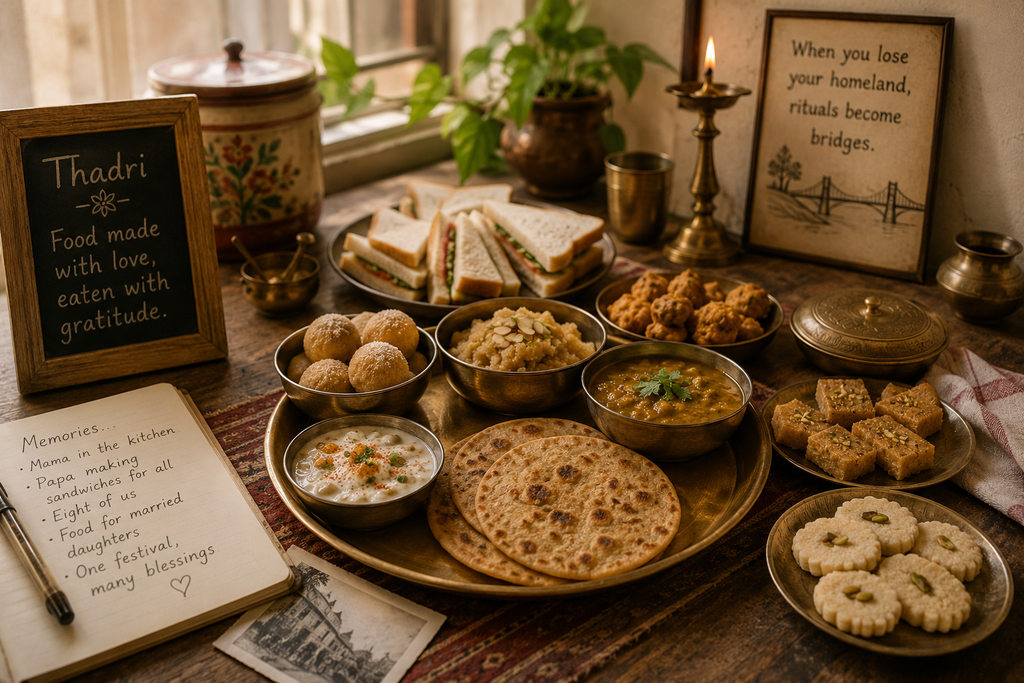
There would be lolo, koki, dal paratha, pakoras, sweets, biscuits, chutneys and whatever else our family prepared for the occasion.
Food would be made in abundance.
And then, on Thadri, the stove stayed off.
I have to admit something:
I was never particularly fond of the very sweet, ghee-heavy or fried Thadri foods.
Even as a child, I would sometimes take just a bite of mitho lolo and leave it.
Today, I find that quite amusing.
Because when I think about Thadri now, I don’t actually remember one particular dish.
I remember my family.
I remember my mother working in the kitchen.
I remember food being shared.
And I remember my father making sandwiches.
He would take two loaves of bread and make sandwiches for all of us — and there were eight children.
Chutney would be prepared, everything would be put together, and somehow there was enough for everyone.
That, too, was our Thadri.
Not necessarily the perfect traditional menu.
Not a picture-perfect thali.
Just a family finding its own way to celebrate.
Food was also sent to married daughters and sisters in our family — a little dana, a gift of food and love from home.
In that way, the food travelled.
And so did the feeling:
You are still part of us.
So What Exactly Is Thadri?
Traditionally, Thadri — also called Vadi Thadri or Vadi Satai in Sindhi tradition — is associated with Sheetla (Sitala) Mata, a goddess connected in Hindu traditions with cooling and protection from disease.
The word thad carries the sense of coolness/cold.
One of the defining practices is simple:
Food is prepared the previous day, and on Thadri the household traditionally does not light the cooking fire.
The prepared food is eaten cold.
Traditional Sindhi Thadri foods can include dishes such as lolo, koki, parathas, pakoras, curd-based foods and other preparations, although what families make varies.
Historically, the festival also carried prayers for the health and protection of the family, particularly against contagious and seasonal illnesses.
In a world before modern medicine, diseases such as smallpox were a very real threat.
Today, smallpox has been eradicated, and we understand illness very differently.
But the human desire behind the ritual remains remarkably familiar:
May my family be safe.
May my children be healthy.
May the home be protected.
And perhaps that is one reason traditions survive.
Their forms may change.
But the love underneath them doesn’t have to.
Maybe Thadri Is Really About “Cooling”
The more I think about Thadri, the more I like the symbolism of cooling.
Not just cooling the kitchen.
Not just cooling the food.
But cooling ourselves.
Cooling the rush.
Cooling the anger.
Cooling the need to constantly do.
Cooling the mind that is always thinking about what comes next.
Cooling the part of us that believes we must always be producing something.
For one day, the kitchen doesn’t have to perform.
The woman of the house doesn’t have to keep cooking.
The family eats what has already been created.
There is something beautiful about that.
You don’t always have to create more.
Sometimes, you can simply receive what has already been created.
But There Is Another Reason Thadri Matters to Me
And this is the part I didn’t understand as a child.
Thadri is also a festival of cultural memory.
Because what happens when a community loses its homeland?
The Sindhi Hindu community experienced a profound rupture during the Partition of 1947.
People left Sindh.
They left homes.
They left neighbourhoods.
They left ancestral places.
They left behind the physical landscape that had held generations of memories.
And then they had to rebuild.
Many rebuilt their lives in different parts of India and across the world.
But you cannot put an entire homeland into a suitcase.
So what can you carry?
Your language.
Your food.
Your songs.
Your stories.
Your rituals.
Your festivals.
Your memories.
And that is why I have started seeing festivals differently.
When you lose your homeland, rituals become bridges.
A festival becomes a little piece of home that can travel.
Academic research on diaspora Sindhis has explored precisely this question — how cultural identity continues to be reproduced after Partition, even as communities move, languages change and generations grow up away from Sindh. Recent scholarship has also examined how digital spaces are becoming important places for Sindhis to remember, discuss and reshape their cultural identity.
And suddenly, Thadri feels much bigger to me than a plate of cold food.
What Do We Pass On to Our Children?
This is something I think about now as a mother.
My daughter has not been taught the traditional lolo recipe.
And I don’t think that makes me less Sindhi.
I don’t believe preserving culture means forcing the next generation to reproduce everything exactly as we did.
Because cultures are living things.
They evolve.
Families evolve.
Food evolves.
Homes evolve.
Technology changes.
The world changes.
But I do believe that children deserve to know the story.
Maybe they will celebrate differently.
Maybe they won’t make ten traditional dishes.
Maybe they will make one.
Maybe they’ll make a healthier version.
Maybe they’ll eat something completely different.
That’s okay.
What matters is that they know:
This is ours.
This came from somewhere.
Our grandparents celebrated it.
Our parents remember it.
And now we get to decide how we carry it forward.
Don’t Silence the “Why”
Perhaps this is why I feel differently about the questions I asked as a child.
A child asking:
“Why do we do this?”
is not necessarily rejecting the tradition.
Sometimes the child is actually asking:
“Help me understand my culture.”
So don’t silence the question.
Answer it.
And if you don’t know the answer?
Say:
“I don’t know. Let’s find out.”
That may be one of the most beautiful ways to preserve a tradition.
Not by demanding blind obedience.
Not by dismissing it as old-fashioned.
But by becoming curious enough to understand it.
We Don’t Have to Preserve the Plate Exactly
I also don’t think we need to turn tradition into another source of pressure.
We don’t have to prepare enormous quantities of food just because that’s how it was done before.
We don’t have to force ourselves to eat foods we don’t enjoy.
We don’t have to reproduce our mother’s kitchen perfectly.
We can make smaller quantities.
We can adapt recipes.
We can make food that suits our families today.
We can even remember Thadri through something as simple as a family meal and a story.
Because the real question isn’t:
“Did I recreate the exact Thadri my mother made?”
The question is:
“Did I keep the connection alive?”
Preserve the Story. Let the Form Evolve.
Maybe this is what I want to pass forward.
Preserve the story.
Preserve the gratitude.
Preserve the connection.
Preserve the food memories.
Preserve the language.
Preserve the sense of community.
But allow the form to evolve.
Because preserving culture doesn’t mean freezing it in time.
It means carrying its essence forward.
I Am Not Trying to Recreate My Mother’s Kitchen
I think about my mother preparing all that food.
I think about my father making sandwiches for eight children.
I think about married daughters receiving food from home.
I think about myself as that little girl asking question after question.
And now I realise something.
I am not trying to recreate my mother’s kitchen.
I am trying to remember it.
And perhaps that is enough.
My daughter may remember Thadri differently from the way I remember it.
She may not remember the exact dishes.
She may not learn every recipe.
But I hope she remembers that her mother cared enough to tell her:
“This is our Thadri.”
And if one day she asks me:
“But why?”
I hope I never say:
“Because that’s how we do it.”
I hope I say:
“Let’s find out.”
A Festival Is a Little Piece of Home That Can Travel
For communities that have experienced displacement, festivals can become more than celebrations.
They can become memory.
They can become identity.
They can become a bridge between generations.
They can become a way of saying:
We came from somewhere.
We remember.
We are still connected.
And perhaps that is why a festival like Thadri deserves to be remembered — not because every generation must celebrate it in exactly the same way, but because every generation deserves the opportunity to understand why it mattered to the generation before them.
Because when a people lose the physical connection to their homeland, sometimes a festival becomes a doorway back home.
And Now, I Want to Hear From You
What are your memories of Thadri?
Did your mother or grandmother prepare lolo, koki, dal paratha, pakoras — or something completely different?
Did your family have its own version of the tradition?
Did you ever ask “Why do we do this?”
And what does Thadri mean to you today?
I would genuinely love to hear your memories, your thoughts, or even your questions.
Share them in the comments below.
Because perhaps this is how we keep culture alive too —
not only by remembering our own stories, but by hearing each other’s.
Happy Thadri ❤️
May we keep what is beautiful.
May we question what we don’t understand.
May we remember where we came from.
May we pass the stories forward.
And may we allow the next generation to carry them in their own way.
Thadho raho — bahar bhi, andar bhi.
— Honey Vachhani
Identity Transformation Coach